Cremona Polytechnic Issues an Appeal to Industry Associations:
“Sharing Data Makes a Difference – in Livestock Farming, Assessment and Innovation”
Cremona, 26 November 2026 – Artificial intelligence is being discussed everywhere, often in conflicting terms: on the one hand, promises that seem limitless; on the other, fears, cyberattacks and the feeling that technology is getting out of control. At the Zootecniche Cremona International Exhibition in Cremona, taking place from 26 to 28 November, artificial intelligence enters the farm without slogans or alarmism.
Today, 26 November, Luciano Baresi, Vice-Rector of the Cremona Campus of the Polytechnic University of Milan, delivered a conference entitled “AI in Livestock Farming”, aimed at explaining to farmers what lies behind these technologies and what they can already do today for those working with animals.
“Artificial intelligence is surrounded by both wonderful and frightening claims, and those listening often lack the tools to tell the difference,” explains Baresi, whose work at the Polytechnic focuses on software. “I would like to clarify a few key points, starting with the basics: what do we mean when we talk about artificial intelligence? What is machine learning? What lies behind a tool such as ChatGPT, which we now all use? Only then does it make sense to ask what these technologies can change in a livestock farming business.”
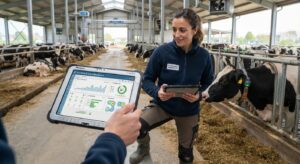
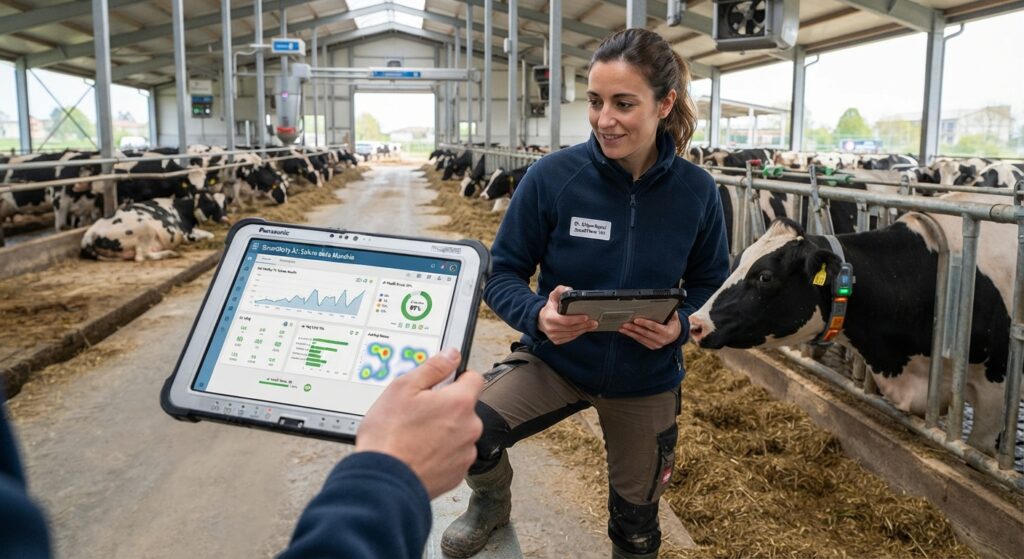
The starting point is more practical than one might imagine. “If we use artificial intelligence to analyse data, we can do so with a farm’s production data just as we would with data from an industrial plant,” the Vice-Rector points out. “A farmer can ask how they are feeding their cows and whether better feeding could lead to higher milk production. The possibilities are virtually endless, but some applications are already within reach of farming businesses.”
Baresi gives an example related to one of the sector’s most pressing concerns: environmental impact. “Analysing data on the gases produced by animals to understand how to feed them in ways that reduce pollution is a project that can already be implemented today.”
Further ahead lies the field of research, where opportunities grow alongside complexity. Baresi mentions genetic selection, the study of breeds and bloodlines, and the relationship between animal welfare and milk quality and safety. These analyses require close collaboration with laboratories and face one specific limitation.
“The fundamental issue is scale,” he emphasises. “To obtain reliable results, we need to increase the amount of data, and as the scale increases, so do the costs. Everything becomes easier if I can build on results obtained by others and apply them to my own context.”
According to the professor, this is where the most interesting opportunity for Italy’s livestock farming sector lies, as it is largely made up of small and medium-sized businesses.
“If I have fifty animals in my farm, there is only so much I can do in terms of research: statistically speaking, the sample is too small,” he explains. “However, if those data are combined with information from other farms and shared, much more sophisticated analyses become possible.”
For this reason, Baresi envisages a new role for industry associations. “They could take the lead in creating shared databases, a common pool of data available for research and development, where new solutions can be tested.”